

Recognition
Distance degree programs - Accreditation.
Distance Learning University - Recognition.
Bircham International University
Recognition & Accreditation
Bircham International University is accredited, recognized, and is a member of several international bodies. It meets the quality standards of numerous educational organizations in various countries. More info...
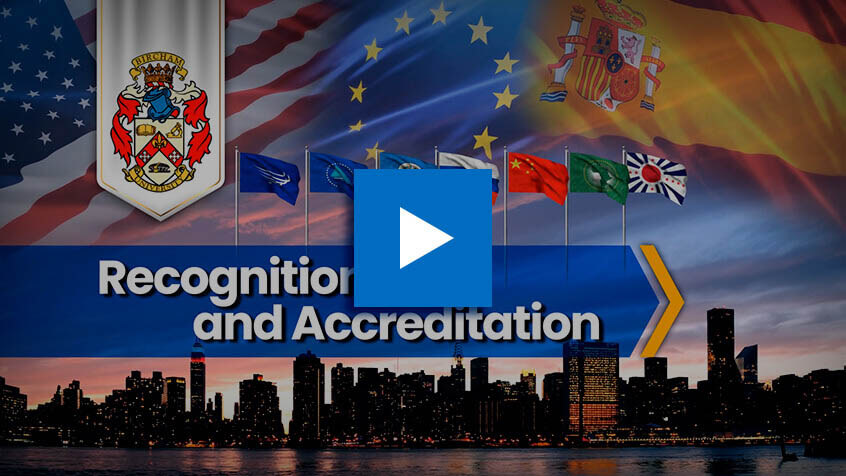
Bircham International University distance learning degree programs meet the current higher education guidelines set forth by the European Union (European Credit Transfer System [ECTS]) as well as the USA (Generally Accepted Accrediting Practices [GAAP]). More info...
AAOU - Asian Association of Open Universities
ABED - Associação Brasileira de Educação a Distância
ACDE - African Council for Distance Education
AHEA - Adult Higher Education Alliance
AIESAD - Asociación Ibero-Americana de Educación Superior a Distancia
BAOL - The British Association for Open Learning
CALED - Latin American and Caribbean Institute for Quality in Distance Higher Education
EADL - European Association for Distance Learning
EDEN - European Distance Education Network
EFQUEL - European Foundation for Quality in eLearning
EFVET - European Forum of Technical and Vocational Education and Training
ESREA - European Society for Research on the Education of Adults
EU Open Education Europa
ICHE - International Council for Higher Education
USDLA - United States Distance Learning Association
More info...
BIU meets the quality criteria set forth by the USDLA regarding our academic quality, institutional integrity, efficacy in our distance learning methodology, and continuos improvement among over 120 standards. More info...
Accreditation - Education Quality
Bircham International University
Recognition and accreditation are a complex topic.
The process of accreditation is non-governmental and voluntary. A distance education university normally appeals for accreditation to a private, regional, or professional association and submit an application. The accrediting institution performs an overall assessment of the university and grants the accreditation, if deemed satisfactory. Note that each accrediting organization holds its own accreditation criteria. No worldwide accreditation standards are currently available for any distance learning higher education institutions such as Bircham International University.
Higher education is usually regulated by national governments, which can enact policies governing educational institutions, and recognizing accrediting bodies, only within their own territory. However, no country has any authority to regulate a distance learning university which is legalized and issues valid diplomas from another country. As free markets, open frontiers, and individualism spread around the world, many nations are adapting to a more liberal, competitive, and diverse distance learning higher education system. Accreditation is one of the leading factors behind this global trend. Accreditation ensures academic quality through peer review.
In the United States of America (USA), there are no Federal Ministry of Education or a centralized authority to exert unanimous national control over post-secondary educational institutions. As a consequence, the USA educational institutions vary widely in the quality and specifics of their programs. USA Accreditation becomes an important factor when it comes to evaluate and recognize the value of a distance learning degree program.
In the United States, the Department of Education does not recognize degrees or educational institutions.
Bircham International University is accredited, recognized, and is a member of several international bodies. It meets the quality standards of numerous educational organizations in various countries. Nevertheless, none of these international bodies are recognized by the Council of Higher Education Accreditation in the USA (CHEA–USA).
CHEA is a USA non-governmental independent association grouping almost 3,000 degree-granting traditional universities. This council recognizes around 60 institutional and programmatic accrediting organizations that provide voluntary and self-regulation processes to ensure academic quality. In the USA, accreditation by CHEA is important for two main reasons: First, it provides standards to academic quality in a country whose Constitution establishes freedom of education. Second, it distributes US Federal Grants among its members. Distance learning higher education organizations are excluded from accessing these federal grants.
It is important to stress that accreditation is not equivalent to legality or recognition; it is a non-governmental and voluntary quality standardization process. More info...
World References
Bircham International University
Accreditation - Education Quality
AAHEA - American Association for Higher Education and Accreditation
EDUCAUSE - Higher Education Through Information Technology
EQAC - Educational Quality Accrediting Commission
IARC - International Accreditation & Recognition Council
Faculty of Arts & Humanities
AIEA - Association of International Education Administrators
APPE - Association for Practical and Professional Ethics
CLACSO - Consejo Latinoamericano de Ciencias Sociales
IACD - International Association for Community Development
IASSW - International Association of Schools of Social Work
ICA - International Communication Association
IEEE ES - Education Society
IPSA - International Political Science Association
ISA - International Sociological Association
ISA - International Studies Association
NAFAE - National Association for Fine Art Education
Faculty of Business & Media
ASIBEAM - Asociación Iberoamericana de Economía, Administración y Marketing
EBEA - Economics & Business Education Association
ECLBS - European Council of Leading Business Schools
FTA - Foreign Trade Association
IAAER - International Association for Accounting Education and Research
IAMCR - International Association for Media and Communication Research
IEEE IAS - Industry Applications Society
IHRIM - International Association for Human Resources Management
POMS - Production and Operations Management Society
UN PRME - Principles for Responsible Management Education
Faculty of Computer Science
ASIST - Association for Information Science and Technology
IACSIT - International Association of Computer Science and Information Technology
IEEE CIS - Computational Intelligence Society
IEEE CS - Computer Society
ISSA - Information Systems Security Association
NetSci - Network Science Society
Faculty of Engineering & Technology
ASEE - American Society for Engineering Education
EASST - European Association of Science & Technology
IACEE - International Association for Continuing Engineering Education
IAENG - International Association of Engineers
IEEE - Institute of Electrical and Electronic Engineers
IEEE PES - Power & Energy Society
IEEE RAS - Robotics and Automation Society
IEEE TEMS - Technology and Engineering Management Society
Faculty of Life & Earth Sciences
CAST - Council for Agricultural Science and Technology
EADI - European Association of Development Research and Training Institutes
IOSR - International Organization of Scientific Research
ISC - International Science Council
Faculty of Natural Health Science
AADP - American Association of Drugless Practitioners
AAMA - American Alternative Medical Association
AHHA - American Holistic Health Association
COFEMEN - Conselho Federal de Medicina Naturopatica
IANHP - International Association of Natural Health Practitioners
IEHA - International Energetic Healing Association
Faculty of Psychology
AHP - Association for Humanistic Psychology
ATI - Asociación Transpersonal Iberoamericana
CPT - Council of Holistic Professional Therapists
IAC - International Association for Counselling
ICP - International Council of Psychologists
WFMH - World Federation for Mental Health
BIU degree programs are not accredited by the US CHEA. More info...

The best Distance Learning University alternative to campus-based higher education.
Top 10 Ranking! More info...
Diploma Recognition
Bircham International University
Is BIU an authorized distance learning degree provider?
Yes, but Bircham International University degrees are exempt from recognition by the Spain Ministry of Education. Independent higher education is authorized by the Ministry of Economy, and supervised by the Ministry of Consumer Affairs. More info...
Based in the European country of Spain, Bircham International University is licensed by registration with the Ministry of Economy of Spain, authorized for “non-formal” (distance learning) higher education and the resulting diplomas (Section 932.2). By classification as “non-formal” (not campus-based), BIU is exempt from any direct regulation by the Ministry of Education of Spain.
Under the framework of European Union law, “non-formal” (distance learning) education is assured greater academic freedom, and thus exempt from direct regulation by any Ministry of Education. Note that some positions at certain government agencies as employers, or some professional licensing bodies, may require degrees which are directly regulated by a national Ministry of Education. In this case, Bircham International University distance learning degrees cannot be used for those particular purposes.
In 2012, the European formal higher education systems and universities were merged as agreed in the Bologna Convention. Since then, European countries are considering how to recognize the full range of an individual’s knowledge, skills, and competence, which requires new approaches to validate such learning experiences. The validation of non-formal education is a priority for the European Union.
Since 2006, Bircham International University transcripts follow the directives of the European Credit Transfer System (ECTS). BIU is member of several institutions that play some advisory role at the European Qualifications Framework (EQF) and the validation of non-formal (distance) learning. More info...
Non formal and independent education, leading to degrees exempt from formal recognition by a Ministry of Education. More info...

Bircham International University is simultaneously registered in the USA (Delaware) and the European Union (Spain). Consequently, all BIU distance learning degrees can be issued and legalized in these countries. More info...
EU Curaçao Ministry of Education (Netherlands)
EU EQF - European Qualifications Framework
EU VIP - Validation of Informal Learning
USA Accreditation References
USA Legal Compliance
USA Non Profit 501c3 Status
More info...
Degree Legalization
Bircham International University distance learning degrees can be internationally legalized with The Hague Apostille (for Hague signatory countries) or Embassy Legalization (for Hague non-signatory countries). More info...
In 2018, the Ministry of Education in Curaçao granted a recognition to Bircham International University. This endorsement, in the form of an official charter, has been published at the web of the Government of Curaçao (Curaçao is a protectorat from the Netherlands, similar to the situation of Puerto Rico with the USA). This charter is one of the steps towards the global and indisputable recognition of the innovative and efficient distance learning higher education adapted to the needs of the working professional that defines Bircham International University. More info...
BIU holds an inter-governmental accreditation, and meets the international standards of the US “Generally Accepted Accrediting Practices” (GAAP), UK “Frameworks for Higher Education Qualifications” (FHEQ), EU “European Qualifications Framework” (EQF,) “European Credit Transfer and Accumulation System” (ECTS), UN “Guidelines for Cross-Border Higher Education”, & UN “Recognition of Qualifications of Higher Education” (Articles 36-37). More info...

Consumer Protection
Bircham International University
Bircham International University is directly regulated and supervised by the Ministry of Consumer Affairs of Spain, to ensure the quality of its educational programs and resulting degrees. The applicable law is the Decree on General Education No.84 of 13 May 2004 (Decreto Enseñanza General No.84 / 2004 de 13 de Mayo). More info...
In 2005, the Spain National Institute of Consumer Affairs (Instituto Nacional de Consumo – INC); under the Ministry of Consumer Affairs, awarded BIU with the official consumer protection seal. In 2011, BIU was audited and granted an Online Trust seal which demonstrates our high level of ethical commitment and responsibility towards consumers. This seal is also part of Ecommerce Europe. More info...
Guidestar Seal of Transparency
Online Trust Seal - Sello de Confianza Online
Spain Ministry of Consumer Affairs (INC)
More info...
Refund Policy
Bircham International University provides a beneficial refund policy for the student: 100% tuition refund within 15 days from the program start; 80% tuition refund within 90 days; and 50% tuition refund within a whole year from the program start. This policy guarantees no financial risk to anyone willing to try the BIU's innovative distance learning higher education for adult professionals. More info...
European consumer protection seals, plus membership into other relevant distance learning organizations worldwide, provide a solid international guarantee to all Bircham International University students in Europe, and the rest of the world. More info...
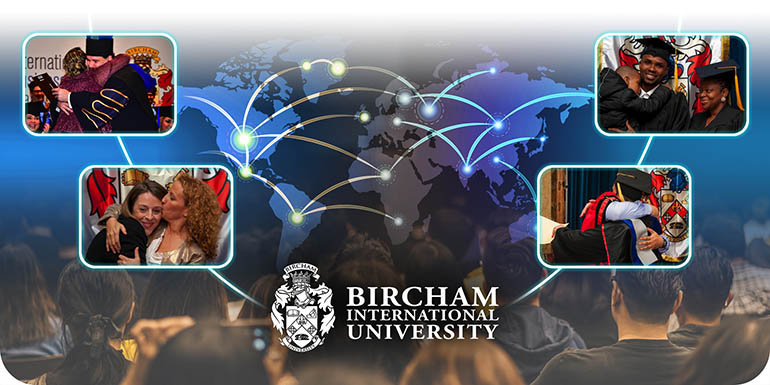
Reputation - Graduates' Testimony, Opinion & Review
A person's professional reputation depends largely on his achievements and competence. It also relies on the know-how acquired through a good education, which is finally represented by the corresponding diploma. We should not forget that a company hires problem solving skills and not just a degree.
For most companies, completing a distance learning university program is as valid as attending classes at a formal university campus. In fact, completing an distance learning university degree program demonstrates an indisputable level of willpower, responsibility, motivation, and personal organization. These skills are highly appreciated at the workplace and explain why Human Resources executives esteem those employees earning distance degrees. More info...
Bircham International University provides much more than a diploma. The graduation set documents provide a comprehensive report of your academic achievements, credits earned and transferred, course descriptions, program textbooks, etc... The Graduation set documents do prove the extent and depth of your program of study at BIU.
These documents are: Diploma, Diploma Supplement, Transcript, Evaluation Reports (Academic Evaluation Control Form), Research Evaluation Form (Thesis or Projects). Additionally BIU provides an Official Diploma Translation (with your picture) and a Transcript Attachment describing all the courses earned at BIU in several languages. Original copies of any of these documents may be issued from Europe or the USA.
BIU distance learning degrees and transcript are signed by a Doctor from a formal traditional university, the President of BIU, and the Registrar official. These documents do not specify distance education. The diploma and other graduation documents will always be issued in English. More info...
Many Bircham International University graduates have gotten jobs or promotions at leading companies worldwide. More info...
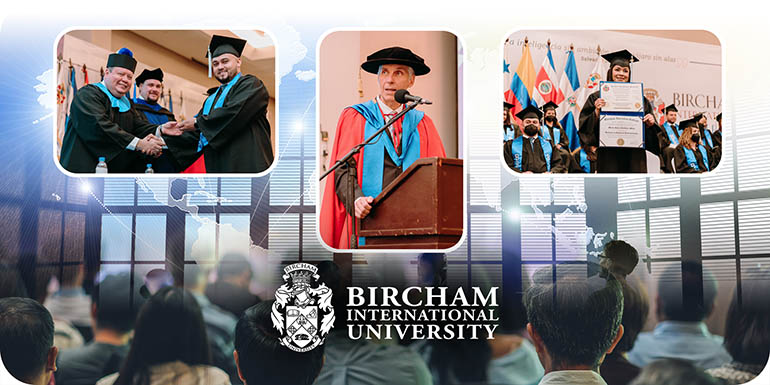
A Distance Learning University provides more than just a DEGREE.
It unquestionably proves your skills. More info...
Professional Practice - Academic Acceptance
Bircham International University
Acceptance of these distance learning higher education academic credits is always the prerogative of the receiving institution or employer. Recognition criteria differ depending on each educational institution, or company policy, or country legal framework. There are no universal criteria for recognition and/or accreditation. Each country, region or institution has its own. More info...
Professional Practice
Joining the proper association is the best way to become an updated professional. More info...
Each profession develops its own entry requirements. Potential BIU students are advised to check, prior to enrollment, whether a Bircham International University distance learning degree is accepted at the professional practice they are seeking. Requirements for a particular profession vary widely among provinces, states, or countries. Some jobs require degrees recognized solely by a Ministry of Education; while others accept a diploma duly legalized or endorsed by a professional association.
Professional practice depends on a student experience and career and not only on the university degree. In other words, a student may qualify for a particular practice while others may not, despite holding the same degree from the same distance learning university.
Bircham International University graduates may join many professional associations. Membership requirements for each association may vary depending on the degree program, specialization and graduate resume en each occasion. BIU can not guarantee membership in all instances. BIU does not intermediate in these procedures. Bircham International University provides a list of available memberships and professional references from each faculty where some BIU graduates may belong. Contact directly the ones you select. More info...
Professional References Network
Bircham International University has compiled the largest network of organizations for professional support of its more than 270 specialties. We want to share this information with you, whether you are a BIU graduate or not.
We include a link in each of our 7 faculties so you can see the complete list of recommended professional references. Each BIU specialization program presents a selection of the most relevant professional organizations.
Faculty of Arts & Humanities - See List...
You must be the change that you wish to see in the world. The best way to predict the future is to invent it.
Recommended Professional References. More info...
Faculty of Business & Media - See List...
If not us, who? If not now, when? Build your own dreams, or someone else will hire you to build theirs.
Recommended Professional References. More info...
Faculty of Computer Science - See List...
Knowledge has a beginning but no end. There is no finish line. So love the journey.
Recommended Professional References. More info...
Faculty of Engineering & Technology - See List...
Excellence, then is not an act but a habit. Knowledge is a treasure, but practice is the key to it.
Recommended Professional References. More info...
Faculty of Life & Earth Sciences - See List...
Anyone can know. The point is to understand. The best questions are the ones that create the most uncertainty.
Recommended Professional References. More info...
Faculty of Natural Health Science - See List...
Our bodies are our gardens, our wills are our gardeners. Every human being is the author of his/her own health or disease.
Recommended Professional References. More info...
Faculty of Psychology - See List...
The only person you are destined to become is the person you decide to be. All our dreams can come true.
Recommended Professional References. More info...
Companies of today value those who demonstrate the will power, responsibility, motivation and capacity for self-improvement required by studying at a distance learning university.
Don't you deserve this professional recognition? More info...

BIU OFFICES - Distance Learning University - Contact ...
If you have any further questions, please let us know. :)